What Makes a UUID Unique in Theory and Practice
To understand whether a UUID can collide, we need to look at its structure and generation mechanisms.
A UUID is a 128-bit value. In canonical textual form, it looks like this:
550e8400-e29b-41d4-a716-446655440000
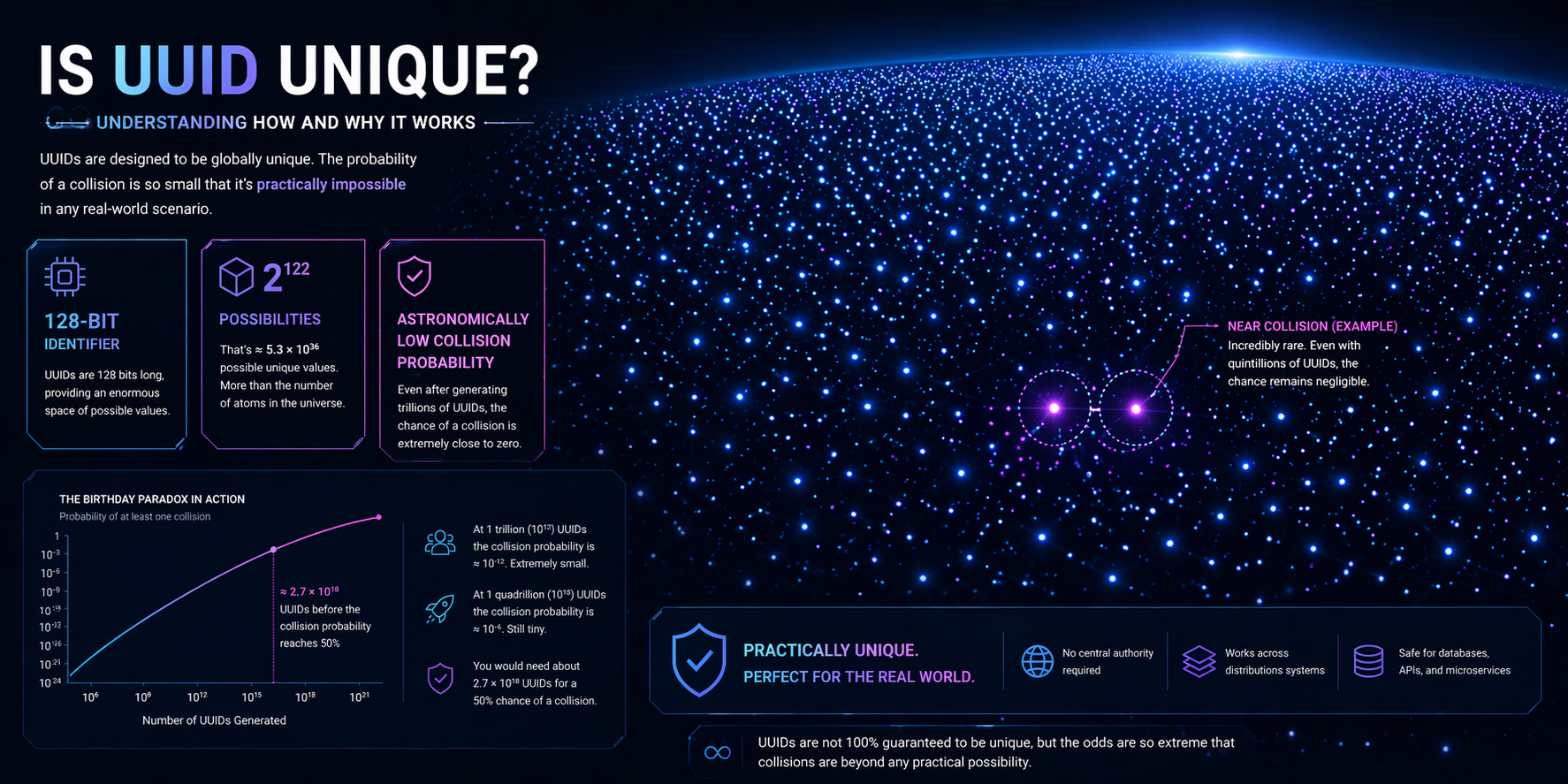
With 128 bits, the total number of possible combinations is:
2^128 ≈ 3.4 × 10^38
That is an astronomically large space. Even generating billions of identifiers per second for millions of years would not exhaust it.
Versions and Entropy Sources
There are several UUID versions defined in RFC 4122 (and updated drafts). The most commonly used are:
- Version 1 (Time-based) – Uses timestamp + MAC address.
- Version 4 (Random-based) – Uses cryptographically strong random numbers.
- Version 3 and 5 (Namespace-based) – Deterministic hash of namespace + name.
- Version 7 (Time-ordered, modern draft) – Combines timestamp with randomness for better indexing performance.
Each version achieves uniqueness differently:
|
Versión |
Fuente de singularidad |
Riesgo de colisión |
Caso de uso típico |
|
v1 |
Marca de tiempo + MAC |
Muy bajo (basado en hardware) |
Sistemas heredados |
|
v4 |
122 bits aleatorios |
Extremadamente bajo |
Sistemas distribuidos |
|
v5 |
Hash del espacio de nombres SHA-1 |
Determinista |
Identificadores estables basados en nombres |
|
v7 |
Tiempo + aleatorio |
Extremadamente bajo |
Bases de datos, inserciones ordenadas |
In practical systems, version 4 and version 7 are most common.
UUID uniqueness guarantee: What It Actually Means
The term UUID uniqueness assurance is often misunderstood. UUIDs do not mathematically guarantee absolute uniqueness. Instead, they provide probabilistic uniqueness with such an enormous address space that collisions are practically negligible.
Probability of Collision (Birthday Paradox Perspective)
For random UUID v4:
- 122 bits are random.
- Collision probability after generating 1 billion UUIDs is approximately:
~1.47 × 10^-15
To reach a 50% collision probability, you would need to generate around:
2^61 ≈ 2.3 × 10^18 UUIDs
That scale exceeds realistic system requirements.
Practical Example
Imagine:
- 1,000 servers
- Each generates 10 million UUIDs per day
- For 100 years
Even at that scale, collision probability remains negligible.
This is why engineers confidently use UUIDs in:
- Globally distributed databases
- Multi-region SaaS platforms
- Event-driven architectures
- Client-side ID generation in offline apps
Why UUID Is Unique in Distributed Architectures
The question of UUID uniqueness often arises in the context of distributed systems where no central authority assigns IDs.
Traditional approaches:
- Auto-increment integers require a central database.
- Snowflake IDs require coordination or timestamp management.
UUID advantages:
- No central coordination required.
- Safe offline generation.
- No dependency on clock synchronization (v4).
- Practically collision-resistant at internet scale.
Example: Microservices Environment
Suppose you have:
- User service in US-East
- Order service in EU-West
- Inventory service in Asia
Each service independently generates identifiers. With UUID v4:
- No communication required.
- No ID registry.
- No coordination latency.
- No global lock.
This drastically reduces system coupling.
Is UUID Always Unique? Understanding Edge Cases
Now let’s address a critical concern: whether UUIDs remain unique in all cases.?
The short answer: No system can guarantee absolute uniqueness unless it tracks all generated values globally. UUIDs rely on probability and entropy quality.
Edge Case 1: Poor Random Number Generator
If your system:
- Uses a weak PRNG
- Has insufficient entropy at boot
- Runs in virtualized environments with shared entropy pool
You may theoretically generate identical random sequences.
Real-world example:
- Early Linux systems in VMs sometimes started with low entropy.
- If applications generated v4 UUIDs immediately at startup, collision probability increased.
Mitigation:
- Use cryptographically secure RNG.
- Ensure entropy pool is properly seeded.
- Avoid custom UUID implementations.
Is UUID Really Unique Under Heavy Load?
The phrase UUID uniqueness under heavy load often appears in high-throughput database discussions.
Let’s examine two concerns:
1. Storage Index Collisions vs Value Collisions
In databases:
- B-tree fragmentation can occur.
- Random UUIDs degrade insert locality.
- This is not a collision problem.
- It is a performance issue.
Solution:
- Use UUID v7 or ULID for time-ordered inserts.
- Or use binary(16) storage instead of string.
2. Deterministic UUID (v5) Reuse
If you use namespace-based generation:
UUIDv5(namespace, "user@example.com")
You will always get the same output.
This is expected behavior.
But if different systems use identical namespace + name combinations, collisions are intentional and deterministic.
How Does a UUID Maintain Uniqueness Across Billions of Devices?
The question how can a UUID be unique across global infrastructure comes down to scale math and entropy isolation.
Consider:
- 122 bits random.
- Each bit independent.
- Uniform distribution.
This produces a search space so large that even if:
- Every human on Earth generated 1 million UUIDs per second,
- For 100 years,
The collision probability remains negligible.
Key reasons:
- Massive bit space.
- Cryptographic randomness.
- No central reuse of sequences.
- Independent generation.
When UUID Is Not Unique: Realistic Scenarios
Although extremely unlikely, situations involving UUID duplication may occur:
- Custom UUID generators with flawed implementations.
- Hardcoded UUID constants reused accidentally.
- Database restore from backup without resetting application state.
- Snapshot cloning of VM before RNG reseeding.
- Truncated UUID storage (e.g., storing first 8 bytes only).
Example: Truncation Mistake
Wrong:
CHAR(8)
Correct:
BINARY(16)
If you truncate UUIDs, collision probability skyrockets.
Detecting and Handling Duplicate UUID Events
Even though rare, you should design defensively against a UUID collision scenario.
Best practices:
- Enforce unique constraints at database level.
- Log collision attempts.
- Retry ID generation if insert fails.
- Use transactional integrity.
Example Pattern (Pseudo-code)
while True:
id=generate_uuid()
try:
insert(id)
break
except UniqueConstraintError:
continue
The retry will almost certainly succeed immediately.
Performance Considerations
UUID uniqueness is only one part of the story.
Storage Recommendations
- Use BINARY(16) instead of VARCHAR(36).
- Avoid storing with dashes.
- Consider time-ordered variants for clustered indexes.
Database Index Impact
Random v4:
- Causes index fragmentation.
- Slower insert locality.
Time-ordered v7:
- Improves page locality.
- Better write performance.
Practical Recommendations
For most modern applications:
- Use UUID v4 if randomness and independence matter.
- Use UUID v7 for database-heavy systems.
- Never implement your own algorithm.
- Never truncate identifiers.
- Always enforce database uniqueness constraints.
Avoid:
- Weak random sources.
- Reusing namespace seeds carelessly.
- Storing UUIDs as plain text without need.
Final Verdict
UUIDs do not offer an absolute mathematical guarantee. However, under correct implementation with proper entropy sources, the probability of collision is so small that it is effectively zero for real-world systems.
They remain one of the safest and most scalable identification strategies for distributed environments.
The practical conclusion:
- Collisions are theoretically possible.
- In correctly implemented systems, they are astronomically improbable.
- Architectural mistakes, not the standard itself, are the real risk factor.
Understanding how UUIDs work at the bit level, how randomness is sourced, and how databases handle them allows engineers to design systems that are both safe and performant at global scale.